






Nano Alumina for Precision Polishing Slurry Formulations
A stable liquid type of abrasive is preferred for nano alumina dispersion liquid for Precursor for Fine Polishing Slurries. Precursor for Fine Polishing Slurries: The nano alumina dispersion liquid provides the formulator with tiny particles of aluminum oxide that are already uniformly dispersed in a carrier, often water. It reduces dust, eases dosing, and enhances mixing repeatability compared to dry powder. It is a starting point, not a completed slurry; therefore, most users still tweak dilution, pH, and additives. In this post, I’ll explain what features are important, how to choose and test a grade, and how to source with confidence.
What Nano Alumina Dispersion Liquid Is and Why Formulators Use It
A Carrier System for Nanoscale Aluminum Oxide
Nano alumina dispersion is a liquid containing nanoscale particles of aluminum oxide equally dispersed in water or any other appropriate medium. pH-control agents, dispersants, or stabilizers to separate particles during storage and usage. It may be supplied to the suppliers either as a ready-to-use liquid or as a concentrate for formulation. In a real slurry at work, the abrasive interacts with the workpiece, pad, carrier fluid, and any chemical additives to remove material and polish the surface. Because that interaction is system-wide, a precursor offers you a consistent baseline, but you still need to check final performance on your tool, pad, and substrate.
Liquid Dispersion Versus Dry Powder
The dry nanopowder should be dispersed before use. Operators have to moisten the powder, break off clusters, and manage dust. It adds effort and varies from batch to batch. That task to the provider is a liquid dispersion movement. It pumps smoothly, dispenses correctly, and creates less airborne dust. For factories that currently operate high-performance dispersion equipment and require complete control, powder still might make sense. The phrases colloidal alumina and nano alumina are used interchangeably in the marketplace; thus, I would advise comparing technical data such as particle-size reports and pH rather than product names. Water-based carriers are dominant because they are easy to handle. Solvent-based carriers need further safety and compatibility reviews.
Where the Precursor Fits in the Formulation Process
The dispersion is like the abrasive layer in a recipe. Formulators may dilute it to the desired solids loading and alter the pH. Other components may be added, such as oxidizers, lubricants, or corrosion inhibitors, depending on the substrate. In a 2010 study in Chemical Reviews, the authors demonstrated how slurry chemistry and abrasive selection affect removal and surface quality in chemical mechanical planarization (CMP). Alumina has been used for many years in metal polishing, particularly tungsten CMP. A regulated precursor provides a repeatable abrasive loading from lot to lot. That makes it easy to discern whether a change in results was chemistry, pad, or tool.
Key Properties That Drive Polishing Performance
Particle Size, Distribution, and Solids Loading
The particle size and distribution affect the removal rate, the roughness, and the development of defects. A tight distribution will maintain cutting depth. A few large particles may scrape even when the average appears acceptable. Therefore, I propose asking for more than the median amount. Please provide distribution data showing the huge particle tail. Nano alumina dispersion liquid for Precursor for Fine Polishing Slurries for metallography typically ranges from ~0.05 µm to 1 µm. Viscosity, dilution flexibility, and transportation efficiency are dependent on solids content. More loading doesn’t inevitably mean better outcomes since it might modify viscosity and removal behavior in ways your process may not accept.
pH, Zeta Potential, and Stability
Particles in stable dispersions resist each other via surface charge. This repulsion is seen as the fundamental cause of the resistance of tiny atoms to clumping in colloid science textbooks, for example, Hiemenz and Rajagopalan, Principles of Colloid and Surface Chemistry. Generally, a zeta potential of more than around 30 mV is indicative of high stability. pH affects surface charge; hence, a change in pH or incompatible addition may cause flocculation and sedimentation. The pH also influences the corrosion behavior and the interaction of the slurry with the workpiece. Assess the grade of sedimentation, re-dispersibility, and storage stability, and the headline pH value.
Purity, Documentation, and Batch Consistency
For semiconductor and optical operations, purity is the most important thing. Trace metals or ions may cause flaws. Industrial-grade alumina may not satisfy those restrictions; therefore, match purity to application. Documentation reveals the degree of control a provider has over the product. Useful documents include Certificate of analysis, particle-size report, trace-metal data, Technical Data Sheet, Safety Data Sheet, and storage recommendations. It is as important to have a good sample as it is to have batch-to-batch consistency; one sample cannot establish long-term stability. I would consider reviewing data from a few manufacturing batches before you decide on a grade.
Comparing Abrasives and Matching Applications
Alumina Versus Silica, Ceria, and Diamond
Alumina is between Softer oxide abrasives and diamond. The type of alumina found in sapphire and corundum is the alpha phase. It has a Mohs hardness of 9. Diamond is 10, and quartz is around 7. This hardness makes alumina a powerful mechanical cutter, suitable for metals, hard ceramics, and sapphire. Colloidal silica is more dependent upon chemical activity and is frequently more suitable for silicon and glass. Ceria is a popular option for glass. Diamond is much harder and is generally more costly. The proper choice relies on substrate, finish goal, defect tolerance, and chemistry; thus, I take any comparison as a test plan, not a rating.
Semiconductor, Sapphire, and Optical Uses
Silicon wafers and semiconductor substrates necessitate tight control of particle size, rigorous purity levels, and careful management of contaminants. Sapphire for LED substrates and optical windows must balance removal rate against haze, subsurface damage, flatness, and edge quality. Low haze and low scratch outcomes are required for optical glass and infrared windows. In each scenario, abrasive selection goes hand-in-hand with pad selection, downforce, and platen speed. Teams adjust these factors together, since aggressive settings might exacerbate scratches or subsurface damage. A steady dispersion will provide a uniform particle delivery to the interface and a more predictable relationship between removal rate and surface finish.
Hard Disks, Ceramics, and Metallography
Very consistent, low-defect surfaces are necessary for hard disk media and electronic substrates. Technical ceramics and precious stones require an abrasive that is hard enough to cut well. Metallography laboratories also use fine alumina, and George Vander Voort's Metallography: Principles and Practice, published by ASM International, discusses final polishing using fine nano alumina dispersion liquid for Precursor for Fine Polishing Slurries and silica solutions. Alumina is widely used by labs for metals, since it is mostly mechanical in its effect. Whatever the field, I recommend that you verify the dispersion with your specific substrate, pad, equipment, cleaning procedure, and approval criteria.
Selecting, Qualifying, and Troubleshooting
A Practical Selection Checklist
Start with the substrate, the goal roughness, the removal rate, the permissible defect level, and whether you will utilize the dispersion as a precursor or as a near-ready slurry component. Particle size, distribution, purity, concentration, pH, viscosity, storage stability, packaging, and traceability must be specified. Confirm compatibility with tanks, pumps, filters, dosing equipment, and additives before scale-up. Include quality systems, capacity, paperwork, technical support, lead time, and export capabilities when you rate vendors. Not simply price per kg, but total cost of ownership, since flaws, rework, and downtime sometimes cost more than the material itself.
Common Problems and How to Avoid Them
Errors occur in several plants. Some teams assign a grade based on nominal particle size alone, some teams ignore agglomeration, and other teams think greater solids polish better. Incompatibility in pH or additives might lead to flocculation, sedimentation, corrosion, or poorer polishing performance. Re-dispersibility may be impaired by vibrations during transport, temperature fluctuations, and long-term storage. Many colloids permanently clump on freezing; therefore, check the storage restrictions of your supplier. Slurry that dries on a pad may produce hard clusters that scrape the surface. These hazards may be reduced by incoming inspection, compatibility screening, stability testing, and documented acceptance criteria.
A Qualification Workflow You Can Follow
Set targets first. Removal rate. Roughness. Haze. Flatness. Defect density. Cycle duration. Concentration, particle size, sedimentation screen grades, purity, pH, viscosity. Lab note. Dilution sequence, mixing speed, order of additives, filtration and holding duration. Removal and surface quality may be measured by, e.g., profilometry, microscopy, haze measurement or particle analysis. Subsequently, pilot experiments were undertaken to demonstrate pumpability, filter loading, circulation stability, and batch homogeneity. Studies on polishing mechanisms, e.g., Luo and Dornfeld modeling, demonstrate that material removal is a function of particles, pad, and pressure combined. That allows testing in production-like environments.
Sourcing and Customization with Yiwei
What to Include in a Request for Quotation
A clear request saves weeks. Please let us know the substrate, application, target particle size, purity, concentration, pH, sample and yearly volume, packaging choice, destination, Incoterms, and documentation required. Ask if the provider manufactures it in-house, how they manage particle size and concentration, and how they test for stability. Request samples from various batches, verify minimum order quantities and lead times for trials and repeat supply. But when you compare quotations, add shipping, storage, labor, powder handling, waste, faults, and downtime to the unit price. Providing this information generally gets buyers quicker, more helpful replies.
Customized Grades for OEM and High-Purity Needs
Standard goods may not match your particle size, concentration, pH, purity, carrier, or current slurry chemistry. This is typical for OEMs, high-purity users, and factories with proprietary equipment or additives. Particle-size grade, alumina loading, pH range, dispersant system, purity level, packaging, labeling and export documentation are all available to be customized. Good development begins with well-defined aims and approved test methodologies. Then it progresses through lab testing, pilot validation, and multi-batch repeatability testing. “We have a university team working with us in Yiwei on this kind of development work to keep improving our products and follow market demand.”
Yiwei Manufacturing and Quality Control
Yiwei (officially Xi'an Yuwei Putai Environmental Protection Co., Ltd.) has its own plant, with modern manufacturing equipment, innovative production procedures, and a full-process quality control system. These help ensure high quality and consistency from batch to batch for our nano alumina dispersion liquid for Precursor for Fine Polishing Slurries. Our water treatment background is also a plus on the back end. Spent polishing slurry contains suspended particulates, and many companies require a strategy for coagulation, filtering, and discharge compliance. That aspect of the procedure we may explore together with your abrasive demands. Let us know what you are trying to accomplish, and we may propose acceptable solutions without exaggerating what a product can achieve.
Conclusion
Nano alumina dispersion liquid for Precursor for Fine Polishing Slurries with a controlled, liquid abrasive basis for precision polishing slurries, with less dust and simpler dosing than dry powder. Performance is related to variables such as particle size distribution, solids loading, pH, zeta potential, purity, and batch consistency. Alumina is hard and good for metals, sapphire, ceramics, and other hard substrates. Silica, ceria, and diamond are good for other purposes. Abrasives must be chosen according to the substrate and finish aim. Typical failures are due to agglomeration, incompatible additives and poor storage and may be prevented by incoming inspection, stability testing, and phased certification. Results may vary depending on pad, tool and chemical; therefore, application testing is still required. The whole cost should include the costs of faults, rework and downtime. Reliable long-term sourcing is ensured by good specifications and supplier documentation.
FAQ
1. What is nano alumina dispersion used for?
It serves as an abrasive precursor for polishing silicon, sapphire, optical glass, ceramics, and related hard materials.
2. How do I choose particle size and concentration?
The best values depend on the substrate, pad, process chemistry, and target finish. Test several grades under production-like conditions.
3. Why choose a liquid dispersion over dry powder?
It reduces dust, simplifies dosing, and removes the in-house dispersion step. Powder still suits plants with strong dispersion systems.
4. How is stability tested?
Common checks include sedimentation observation, re-dispersibility, particle-size and pH tracking over time, and zeta potential.
5. Which documents should I request?
Ask for the COA, SDS, Technical Data Sheet, purity report, storage instructions, and shelf-life information.
Contact Yiwei for Nano Alumina Dispersion Liquid Samples and Technical Support
Searching for a nano alumina dispersion liquid for Precursor for Fine Polishing Slurries supplier? Yiwei operates its own factory with modern equipment, full-process quality control, and university-backed product improvement. Send your substrate, target particle size, concentration, pH, purity needs, and estimated volume to sales@ywputai.com to request a sample, Technical Data Sheet, or quotation.
References
1. Chemical Reviews, 2010 – Krishnan, Nalaskowski, and Cook, "Chemical Mechanical Planarization: Slurry Chemistry, Materials, and Mechanisms"
2. Materials Science and Engineering: R: Reports, 2004 – Zantye, Kumar, and Sikder, "Chemical Mechanical Planarization for Microelectronics Applications"
3. CIRP Annals, 2003 – Evans et al., "Material Removal Mechanisms in Lapping and Polishing"
4. IEEE Transactions on Semiconductor Manufacturing, 2001 – Luo and Dornfeld, "Material Removal Mechanism in Chemical Mechanical Polishing: Theory and Modeling"
5. ASM International, 1999 – Vander Voort, Metallography: Principles and Practice
6. Wiley-Interscience, 1997 – Hiemenz and Rajagopalan, Principles of Colloid and Surface Chemistry, 3rd Edition
RECOMMENDATIONS
 VIEW MORENano alumina dispersion liquid (gamma phase)
(1)_1794191465789.webp) VIEW MORENano alumina dispersion liquid (alpha phase)
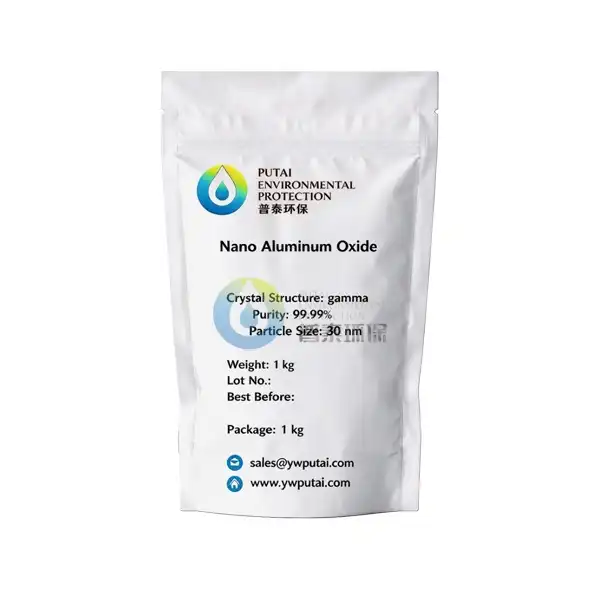 VIEW MORE4N Al2O3 for lithium battery
 VIEW MOREalumina sol for surface insulating coating
 VIEW MOREsubmicron alumina dispersion liquid (alpha phase)
 VIEW MORE4N Al2O3 for Battery separator coating
 VIEW MORE4N Al2O3 for wearproof coating
_1794796395661.webp) VIEW MORE99.99% (4N) Alpha Nano Alumina Powder for Ceramics