






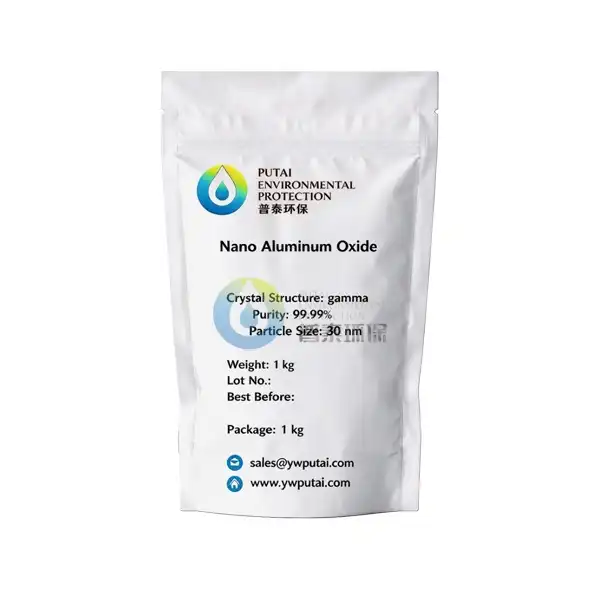
4N Al2O3 for lithium battery
2. Specific surface area: 150–200 m²/g
3. Crystal form: γ-phase
4. Particle size: 30 nm
5. Product application: Cathode materials for lithium batteries
- Product Description
4N Al2O3 for Lithium Battery Cathode Materials: 99.99% γ-Phase 30 nm Nano Alumina for Coating and Doping
Our 4N Al2O3 for lithium battery, γ -phase nano alumina powder with 99.99% purity, 30 nm particle size, and a specific surface area of 150-200 m2/g, can be used by developers of lithium battery cathode materials who need a nano additive for coating or doping. It is provided as a high purity inorganic nanopowder, not a bulk filler, by Xi’an PUTAI Environmental Protection Co., Ltd. and is included in tiny quantities to change the cathode particle surface or crystal structure. Before you order a sample our staff may discuss your route, dispersion medium and trial size.
Alumina is also known as aluminium oxide (Al2O3).
4N Al2O3 for Lithium Battery Specifications
The table lists the parameters provided for this 4N Al2O3 for lithium battery grade.
| Parameter | Specification |
|---|---|
| Purity | 99.99% (4N) |
| Crystal form | γ-phase |
| Particle size | 30 nm |
| Specific surface area | 150–200 m²/g |
| Application | Lithium battery positive electrode material |
| Model | Appearance | Crystalline | Partical size (nm) | Purity (%) | Specific area (m2/g) | Application |
YW-L30D | white powder | γ-phase | 30nm | 99.99 | 150-200 | Lithium battery positive electrode material |
Other parameters, such as impurity limits or moisture content, are not stated in the available product data, so they are not listed here. Please ask our team whether a data sheet or test report can be provided.
Coating and Doping Routes
Surface coating and lattice doping are two methods by which manufacturers of cathode materials can assess 4N Al2O3 for lithium batteries. They both change the cathode particle at the nano level.
Coating the surface
The nano alumina is coated on the surface of cathode particles for coating. The 30 nm particle size and the 150-200 m²/g specific surface area should be taken into account when planning dosage and coverage. Check the actual layer coverage and dosage on your own cathode material.
Dopage
In doping, the nano alumina is incorporated in the lattice of the cathode material instead of staying on the surface. Here purity matters because other things in the powder may also get into the crystal structure. The grade is specified as 99.99% (4N). You may undertake coating and doping tests with the same grade and compare the results on your own line.
Why 30 nm and γ-Phase Matter?
The size and crystal phase of particles influence how a powder will behave in your process. The γ-phase often has greater porosity than the α-phase, which is linked with a bigger specific surface area. This grade is stated at 150–200 m²/g, which signifies increased surface contact per gram of powder and makes it appropriate to surface-driven modification.
The α-phase is commonly selected when hardness or thermal conductivity is the goal, and it is normally tougher to disperse. This product is delivered in γ-phase.
Dispersion and Storage Guidance
Nano powders tend to agglomerate due of their high surface energy, thus schedule the dispersion phase early. High-shear equipment such as bead mills is a typical option, and surface modifiers such as silanes or surfactants should be suited to your solvent solution. Validate the approach on your own material.
Nano alumina particles may take up moisture, which may cause caking. Keep containers sealed and keep them in a dry area. If a powder has been kept for a long period, a Loss on Ignition (LOI) test before usage might indicate the moisture content. Transmission Electron Microscopy (TEM) may assist evaluate whether the dispersion is at nano size.
Separator Slurries
Nano alumina is also employed in ceramic-coated separator slurries in general. The product data presented is for cathode alteration only and compatibility for separators have not been proven. If you are working on separators, get in touch with our team to discuss your needs.
Purchasing Considerations for B2B Buyers
Get these details ready before sending an inquiry:
- Your path, doping or coating.
- Your solvent system and dispersing media.
- Target dose and trial size.
- Annual volume & delivery destination expected.
These factors allow our staff to react with correct information when you ask for a quotation for 4N Al2O3 for lithium battery projects. You may also enquire about customisation required for your process.
About PUTAI
PUTAI Group has been engaged in chemical R&D, manufacture, sales and integrated services since August, 2008. Contact our team for paperwork and test data available for your certification procedure for this grade of nano alumina.
Packaging and Supply
We validate the packaging type and amount sent with every purchase. Just tell us how much you need and where it goes and we’ll provide you the information you want.
FAQ
Q: Do you want the γ-phase or the α-phase?
A: Select γ-phase for surface-driven cathode modification when higher specific surface area is required. If you need hardness or thermal conductivity, use the α-phase, but realise that it is usually more difficult to spread.
Q: How can I reduce agglomeration?
A: Use high shear dispersion (bead milling) with a silane or surfactant suitable for your solvent system. Try out the mixture on a scrap of your own fabric.
Q: Can we test both coating and doping?
A: Yes. You may test coating and doping of the product materials of the same grade and compare the results on your line.
Q: How to verify moisture and dispersion quality?
A: Long-term storage - do a Loss on Ignition test to verify moisture. Transmission Electron Microscopy is done to determine whether the dispersion is of micro size.
Contact Us
Do you have more questions about 4N Al2O3 for lithium battery? Email sales@ywputai.com for samples, quotations and technical details.