





alumina sol for surface insulating coating
There are mainly the following application forms:
1. Forming films by blending with organic resins (silicon steel insulation coating)
2. Inorganic coated magnetic powder (soft magnetic composite material)
3. Preparation of pure inorganic insulating films by sol-gel method
- Product Description
Alumina Sol for Surface Insulating Coating: Alkaline Nano Colloid for Silicon Steel and Magnetic Powder
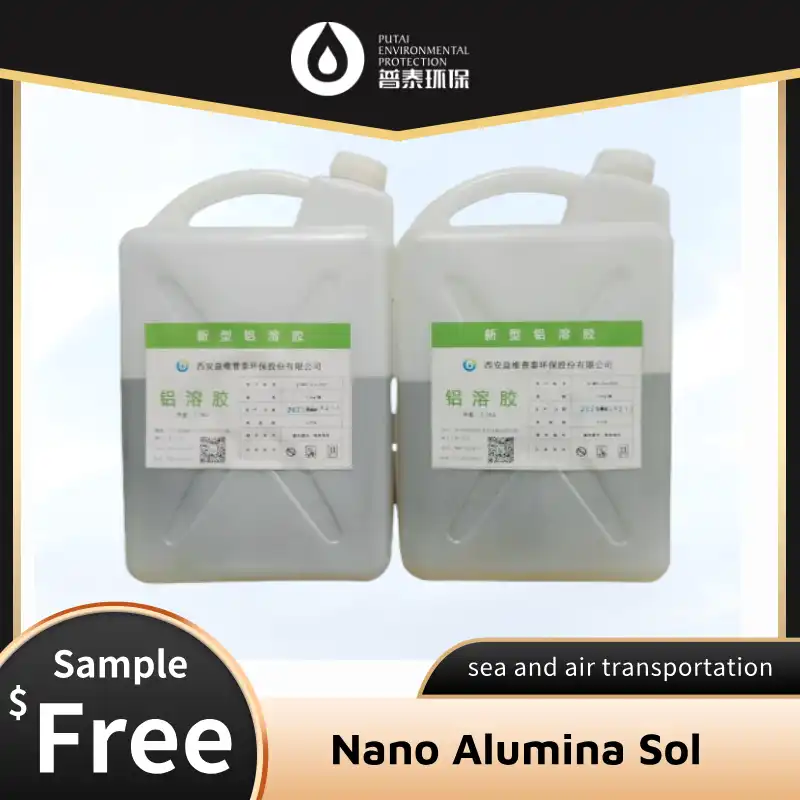
Alumina sol for surface insulating coating, an alkaline nano-scale colloid that may create an aluminium oxide layer following high-temperature treatment, is provided by Xi'an PUTAI Environmental Protection Co., Ltd. for silicon steel and magnetic powder projects. The specified grade has pH 8.0–11.0, D50 particle size 10–50 nm, solids 10–30% and viscosity less than 50 mPa·s at 25 °C. It may be utilised with organic resins, on magnetic powder or in pure inorganic sol-gel films. Let us know your goal pH, solid content and film need and our experts will check it against your line.
What Is This Alkaline Alumina Sol?
It is a simple aqueous colloidal dispersion of nano-sized particles of alumina.
This grade is designed for alkaline environments. Acidic alumina sols are stable only by protonation. It is formulated for use with silica sols, potassium silicates and certain acrylic emulsions.
Addition of an acid component to an alkaline sol may result in flocculation or gelation. Measure the pH of all blending components before combining.
Key Features for Insulating Films
- Oxide layer formation: The aluminium oxide layer offers the insulation and is formed by high-temperature transformation.
- Thin film application: Low viscosity means thin, uniform films.
- Inorganic network: After curing, the film forms a hard inorganic network.
- Storage behaviour: The sol has a strong negative zeta potential in alkaline conditions which maintains the particles rejecting each other and assists in limiting agglomeration in the drum.
Three Application Forms in Insulating Coatings
There are three major uses of alumina sol for surface insulating coating. Each is suitable for distinct product line.
- Silicon steel insulation coating: mix the sol with organic resins and create film on the surface of steel.
- Soft magnetic composite material: The magnetic powder is coated with an inorganic alumina layer. The layer keeps the particles apart and restricts the conduction between them.
- Pure inorganic insulating film: The film is made directly by sol-gel technique and does not include any organic resin.
The optimal recipe would depend on the substrate and the cure procedure. The solid composition and film thickness are normally set by you on the line.
Alumina Sol for Surface Insulating Coating Specifications
| Parameter | Value |
|---|---|
| Particle size (D50) | 10–15 nm |
| pH range | 7–9 |
| Viscosity | 10 mPa·s at 25 °C |
| Solid content | ≥20% |
| Zeta potential | High negative charge in alkaline media |
| Cured film hardness | Mohs 7–8 (up to) |
| Sodium (Na) content | <100 ppm for electronic grade |
| Storage temperature | 5–35 °C |
| Colloidal stability target | 6–12 months |
Other parameters, such as density, packaging, certifications and MOQ, are not specified in the source data and are not listed here. Please ask our team to confirm them for your grade.
Formulation and Storage Notes
Maintain all mixing components at suitable pH above 7. Mixing the sol with acidic resin may produce pH shock and gelation.
Be careful with salt content in your recipe. Salts of high ionic strength might destabilise the sol. Also control the drying rate as too quick drying might create particle aggregation and a hazy layer.
Stabilisers may be amines or sodium/potassium ions. Ask about the stabiliser in the grade you require for electronics, low sodium grades are ideal.
Store drums at a temperature between 5 °C and 35 °C away from direct sunlight. Freezing may disrupt the colloidal structure while sunshine may induce evaporation and peeling.
Conduct a compatibility test with your intended binder before scaling up with the product. Monitor viscosity over time to ensure the pot life is appropriate for your coating procedure.
Quality Checks for Buyers
These are generally checked by buyers and QA engineers for uniformity between batches:
- Colloidal stability and shelf life: Accelerated ageing by centrifugation or heating cycles.
- Particle size via DLS: Dynamic Light Scattering tests D50 versus accepted standard. Increase in size might be an indicator of agglomeration.
- ICP-MS Impurities: Control of Na⁺, Fe, Cl⁻ ions.
- Solid content: Gravimetric analysis, after drying
- Gel time and viscosity development : Compatibility test with your intended binder.
Before buying alumina sol for surface insulating coating, please give your limitations for these things to our staff for assessment about your application.
About PUTAI
PUTAI Group includes R&D, manufacturing, sales and associated service. Xi'an PUTAI Environmental Protection Co., Ltd. was founded in August 2008 and listed with stock number 839410 since November 2016.
The organization has over 16 years expertise in the chemicals for wastewater treatment and drinking water purification. It has two manufacturing sites of over 30,000 m² and 100,000 m². It has a 2.0 project with annual production capacity of 200,000 tonnes and investment of RMB 400 million. These are business level numbers and are not descriptive of this sol in itself.
FAQ
Q1: Is it possible to use this sol with acid acrylic emulsions?
A: Not advisable. pH shock may be caused by an acidic resin, leading to gelation or precipitation. Keep anything above pH 7 and do a compatibility test beforehand.
Q2: What is the relation of this sol to silica sol?
A: This grade is for use with silica sol in alkaline systems. Compare the results with your own binder in your own experiments.
Q3: How does storage temperature affect the material?
A: Store in a dry place, away from direct sunlight, at a temperature between 5 °C and 35 °C. Freezing may affect the colloidal structure.
Q4: Why does the dried coating seem hazy?
A: Haze may be caused by aggregation of particles after drying or by unsuitable additions. Do not use salts of high ionic strength and control the pace of drying.
Q5: Is it acceptable for food contact applications?
A: Food contact data is not available for this grade, thus compatibility cannot be assumed. Discuss your use case with our staff.
Q6: How can I assess batch consistency?
A: Evaluate colloidal stability, DLS particle size, ICP-MS impurity levels, solid content and gel time. Agree boundaries with your provider before you purchase.
Contact Us
Do you have more questions about alumina sol for surface insulating coating? Send your target pH, solid content, particle size and application to sales@ywputai.com.