






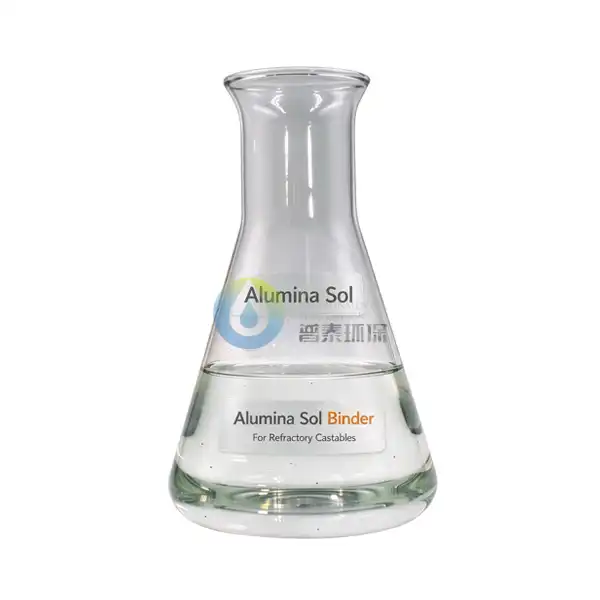
Alumina Sol Binder for Refractory Castables
- Product Description
Alumina Sol Binder for Refractory Castables: Cement-Free Colloidal Bonding
Xi'an PUTAI provides a cement-free colloidal alumina product, Alumina Sol Binder for Refractory Castables, which is manufactured as a dispersion of nano-sized hydrated aluminium oxide in water. It has a solid content of 20%~25% with a colloidal particle size of around 10nm. The pH may be changed from acid to alkaline to suit your system. It is meant for high temperature bonding in castables and coatings thus no cement produced CaO is added to the mix. Send us your formulation and operating temperature and we will discuss appropriateness with you before you place your purchase.
What Is Alumina Sol and How Does It Bond?
Alumina sol is a dispersion of nano-sized hydrated alumina particles in water, separated by electrostatic repulsion. The particles gel and then sinter to create ceramic linkages in the matrix when the castable cures and is burnt.
Calcium aluminate cement (CAC) behaves differently. It introduces calcium oxide (CaO) which may combine with silica and alumina to generate low melting phases such as anorthite or gehlenite. These stages may result in hot modulus of rupture (HMOR) and refractoriness upon load reduction. Alumina sol is a cement free binder, it does not introduce CaO from binder itself, hence it is regarded for cement free castables.
Alumina Sol Binder for Refractory Castables Specifications
The table below lists the data provided for products.
| Item | Specification |
|---|---|
| Product | Alumina sol (colloidal hydrated aluminum oxide) |
| Form | Colloidal dispersion liquid |
| Solid content | 20%–25% |
| Colloidal particle size | Approx. 10 nm |
| pH value | Adjustable from acidic to alkaline, set according to your system |
| Core function | High-temperature bonding for refractory castables and coatings |
| Typical shelf life | More than 12 months when stored at 5 °C–35 °C |
Other values, such as viscosity, Al₂O₃ content, Na₂O content, density and packaging, are not included in the current parameter data, so they are not stated here. Tell us which values your specification requires and we will confirm them during inquiry.
Where It Can Be Used?
Alumina Sol Binder for Refractory Castables is often used when performance is limited by CaO-related phases or cement hydrates. Three common regions are shown below.
- Steel ladles and Tundishes: A CaO-free binder helps to keep calcium-related low-melting phases out of the matrix, which is important for clean steel grades. You will need to do your own tests to verify slag and corrosion behaviour.
- Petrochemical FCC units Linings in fluid catalytic cracking units are subject to abrasion from high velocity particles Often a solid cement free matrix is the design aim.
- Shotcrete and pumpable monolithics: Rapid installation and dry-out are needed for cement kiln and incinerator repairs. Pumping and rebound behaviour are dependent on the whole formulation and must be evaluated.
Mixing and Formulation Notes
The mechanism of setting of alumina sol is gelation, not hydration. Gelling may be caused by a setting agent such as magnesia or certain salts, or by the removal of water by drying. When using MgO, do brief trials to keep the flash set in check.
Some of the basic aggregates like magnesia or doloma may alter the pH and produce immediate flocculation. Select your mixing sequence and deflocculant before your first trial batch.
The green strength is usually lower than in cement castables, since it relies on the dried gel network. A little drying agent can aid in demolding. Fired strength in your formulation review.
Quality Control and Purchasing Checks
When specifying Alumina Sol Binder for Refractory Castables, the buying and QA teams will normally look at the following things to assure batch consistency:
- Stability: No hard caking at the bottom of the drum after centrifugation or after long term observation.
- Particle Size: Verify that the particles stay within the nanometre range using dynamic light scattering (DLS).
- Zeta potential: A measure of whether the electrostatic repulsion is strong enough to overcome flocculation.
- Chemical purity: XRF or ICP-OES for Al₂O₃ and fluxing oxides like Na₂O.
- Rheology: Brookfield viscosity for consistent pumping and mixing behaviour.
Please tell us what checks and acceptance limitations your team has. We will talk to you about them before you order.
Storage and Supply
Store drums in temperature controlled location (5 °C-35 °C). Do not allow the liquid to freeze. Freezing may destroy a colloidal dispersion.
Inquiry will confirm packaging and order quantities. Tell us what you need each month and we will match the supply to your production plan.
About PUTAI Group
Xi'an PUTAI Environmental Protection Co., Ltd. was incorporated in August 2008, and was listed in November 2016 with the stock number 839410. The Group incorporates R&D, manufacturing, sales and associated services, and has RMB 400 million invested in its facilities. The firm has two manufacturing sites with a total area of 30,000 m² and 100,000 m², and a company-wide capacity of 200,000 tonnes per year of high-efficiency chemicals. PUTAI is also a provider of coagulants and other water treatment chemicals in North West China.
FAQ
Q: How does dry-out compare with CAC-bonded castables?
A: The gel network is generally more permeable than cement hydrates, which can let water vapor escape more easily. Follow a dry-out schedule validated in your own trials.
Q: What starts the setting mechanism?
A: Gelation does. Add a setting agent such as magnesia or specific salts, or remove water by drying. Control the flash set when you use MgO.
Q: Is it compatible with all aggregates?
A: Not always. Basic aggregates such as magnesia or doloma can cause instant gelling, so mixing sequence and deflocculant selection matter.
Q: Why is green strength sometimes lower than in cement castables?
A: It relies on the dried gel network. A small amount of drying agent can help demolding, and fired strength should be verified in your formulation.
Q: What are the solid content and particle size?
A: The solid content of the products is 20%–25%, and the colloidal particle size is approximately 10 nm. The pH is adjustable to your system.
Contact Us
Do you have more questions about Alumina Sol Binder for Refractory Castables? Send your castable formulation, target temperature and monthly demand to sales@ywputai.com.

RECOMMENDATIONS
 VIEW MOREAlkaline Alumina Sol Used for Coating Material
 VIEW MOREalumina sol for surface insulating coating
 VIEW MOREalumina sol for FCC catalyst binder
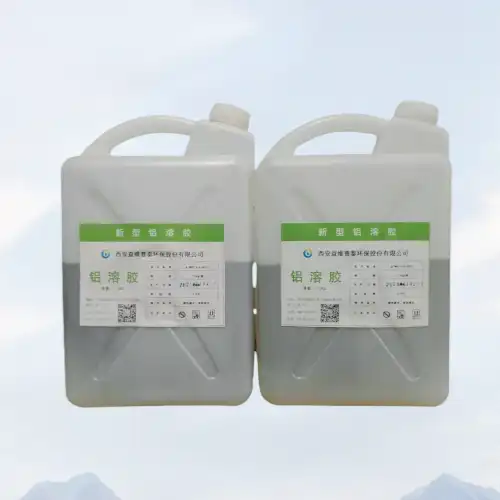 VIEW MOREcolloidal alumina binder
 VIEW MOREcolloidal alumina suspension
 VIEW MORENano aluminum sol catalyst carrier bonder
 VIEW MOREAlumina Sol Gel
 VIEW MOREColloidal hydrous alumina